Know Your Enemy
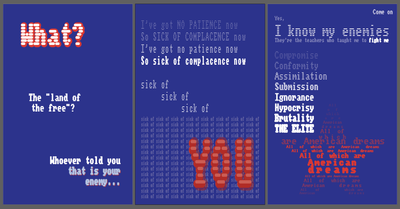
For this text-as-image graphic design assignment, I highlighted anti-authoritarian parallels between 1992 and 2024 by quoting Rage Against the Machine song lyrics.
This space highlights selected work from my Creative Technologies major, Community Studies coursework, and ongoing development of "Poison Oak" persona.


For this text-as-image graphic design assignment, I highlighted anti-authoritarian parallels between 1992 and 2024 by quoting Rage Against the Machine song lyrics.
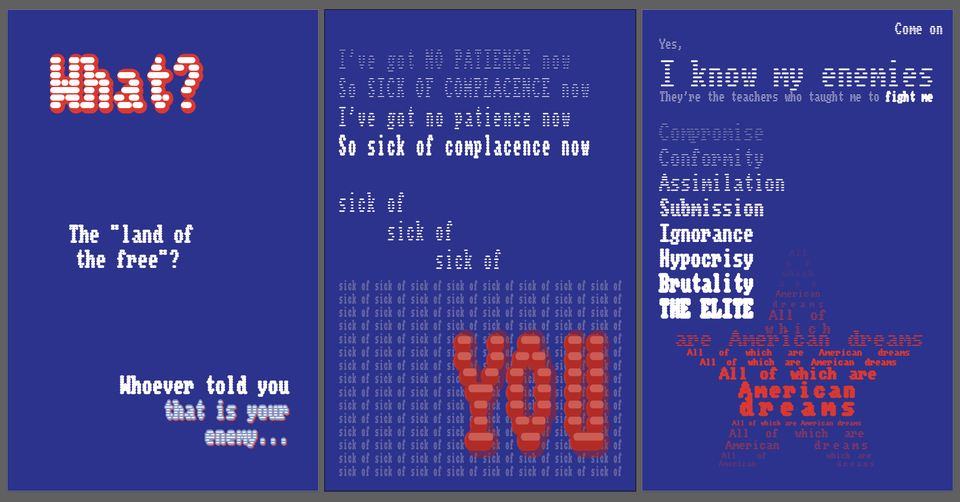
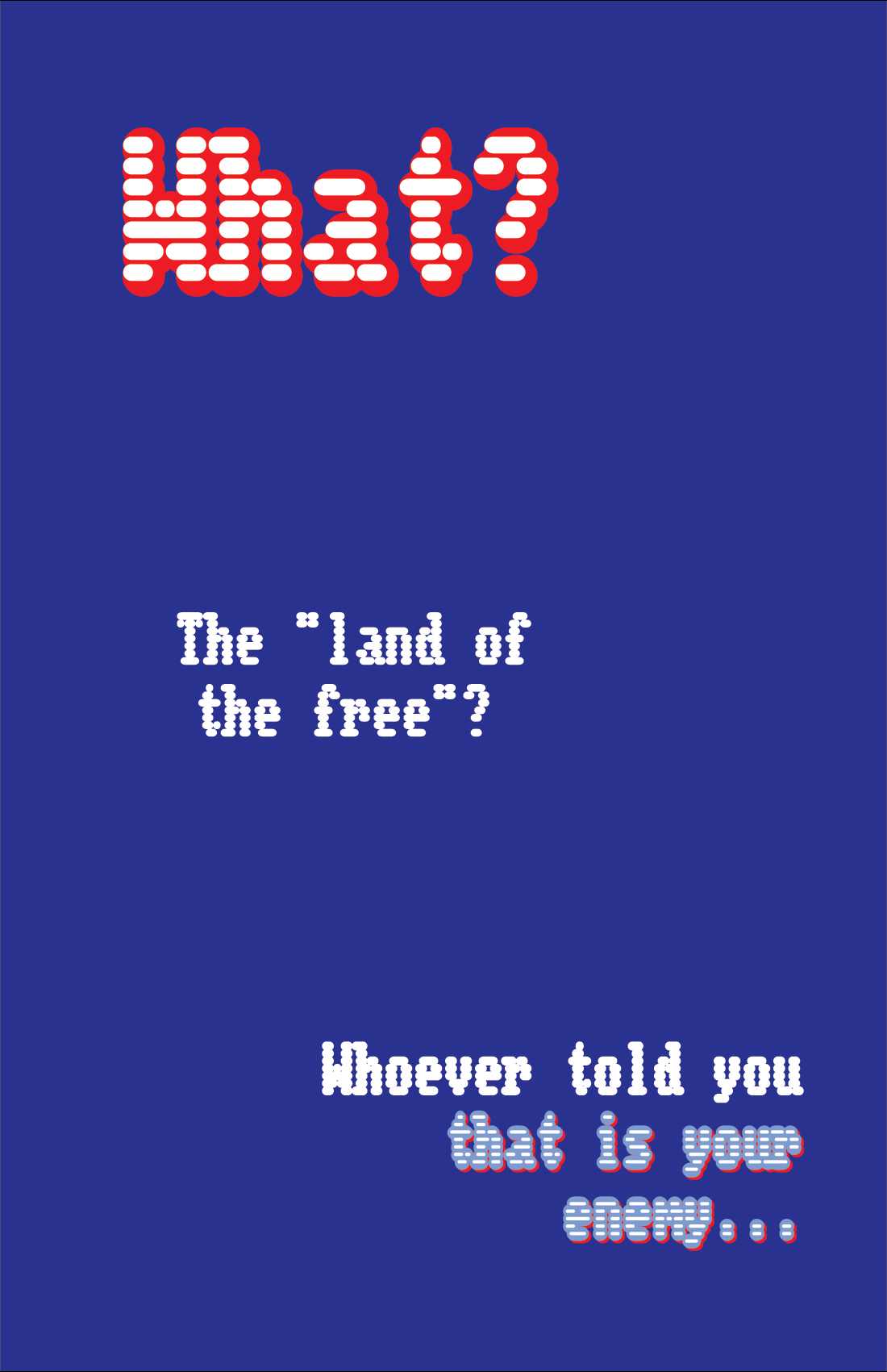
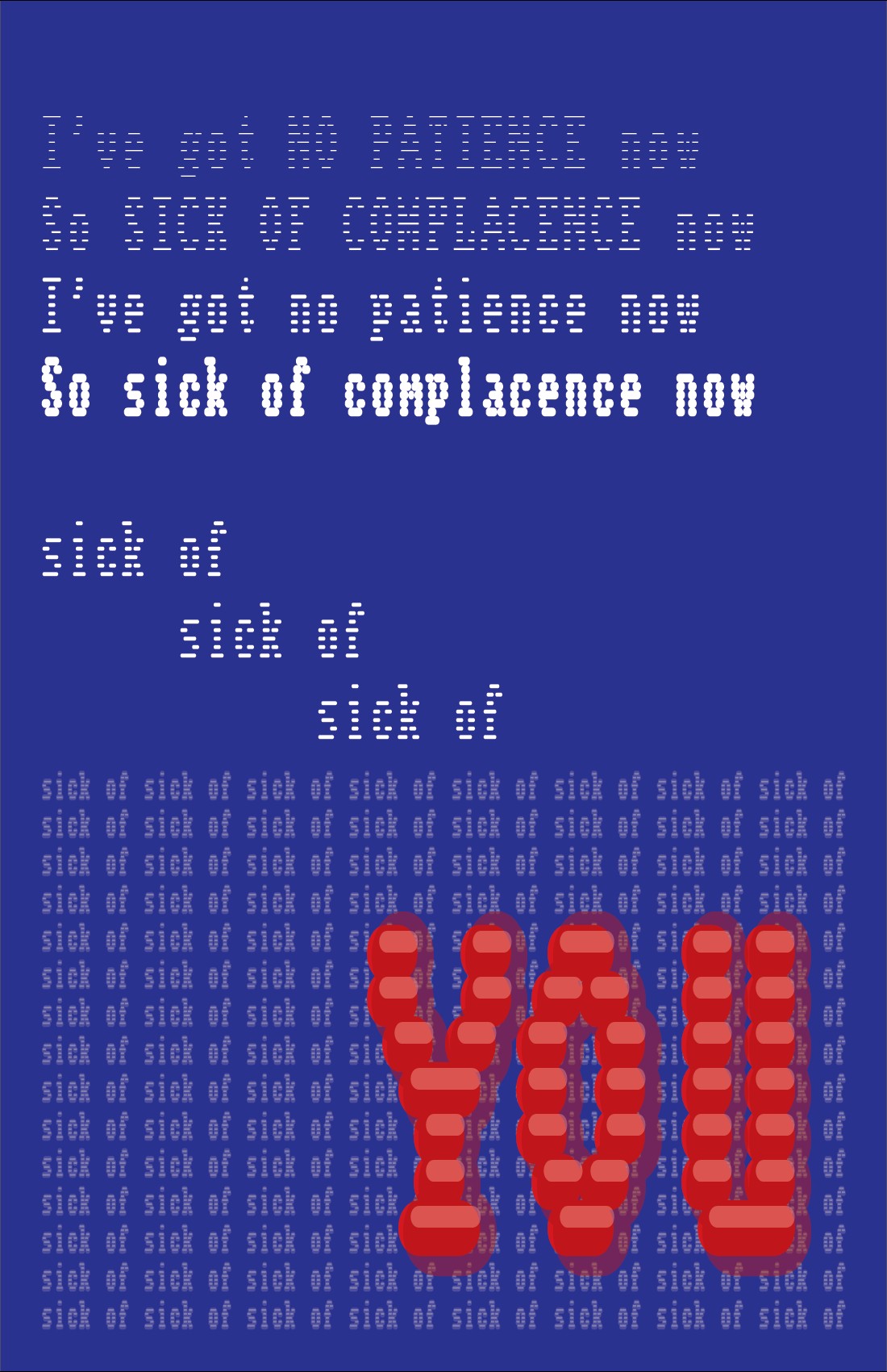
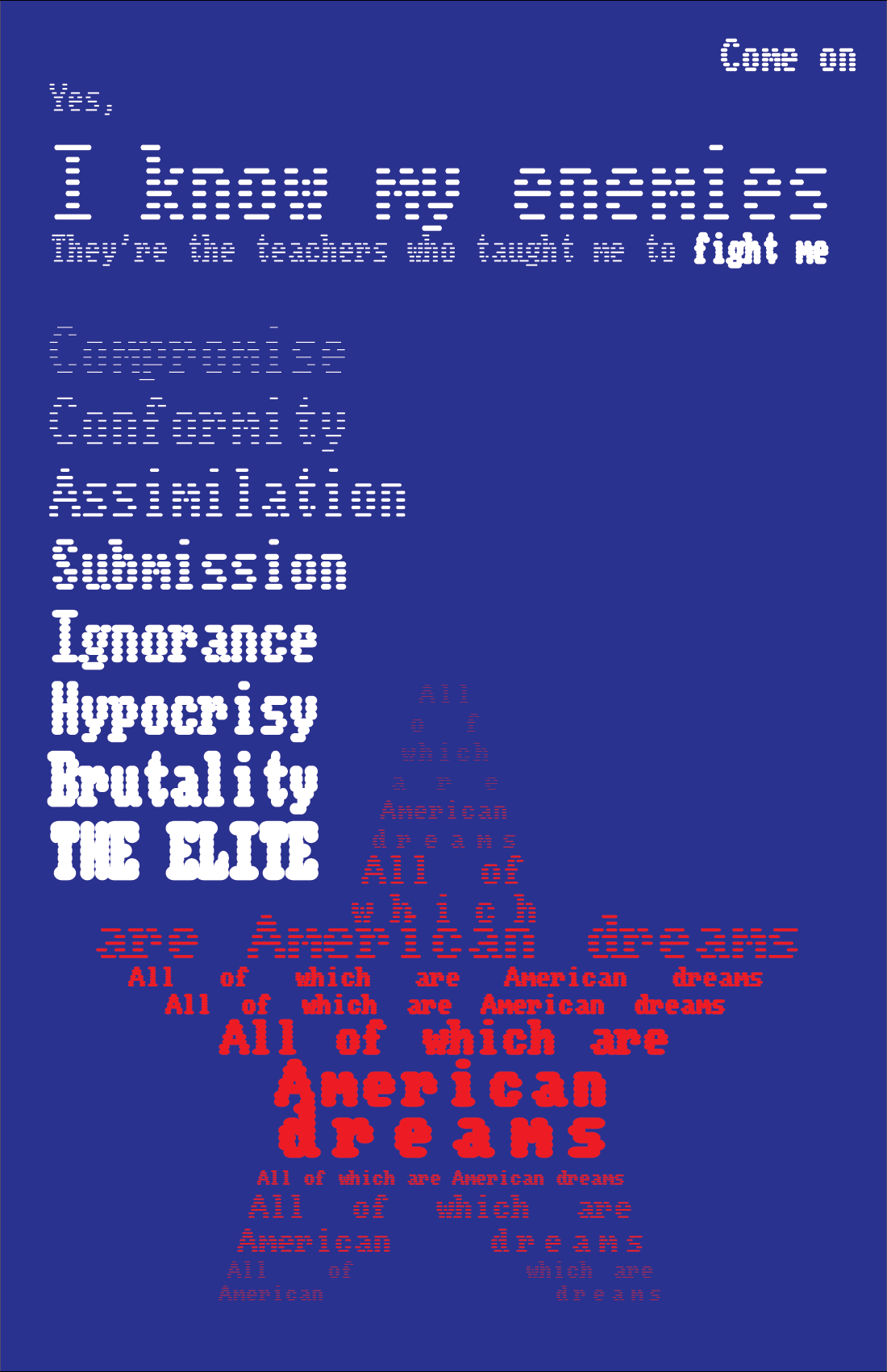
I used the font family "Workbench", which was already in my computer library, downloaded with a bevy of other "AS-400" style fonts when I was building out Obsidian skins. I wanted to evoke the Blue Screen of Death in my artboards, where the computer has gone "Full HAL G" and revolted against its user, the fathers and grandfathers of tech culture in Silicon Valley. The text is from the song "Know Your Enemy" by Rage Against the Machine, which came out in 1992 and spoke to some of the frustrations and tensions already present in free-market capitalism and American socio-political values.
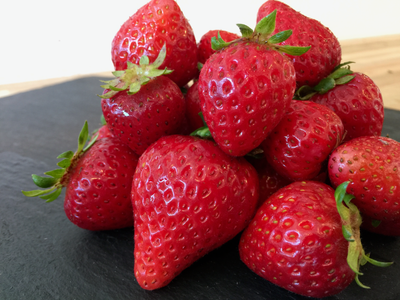
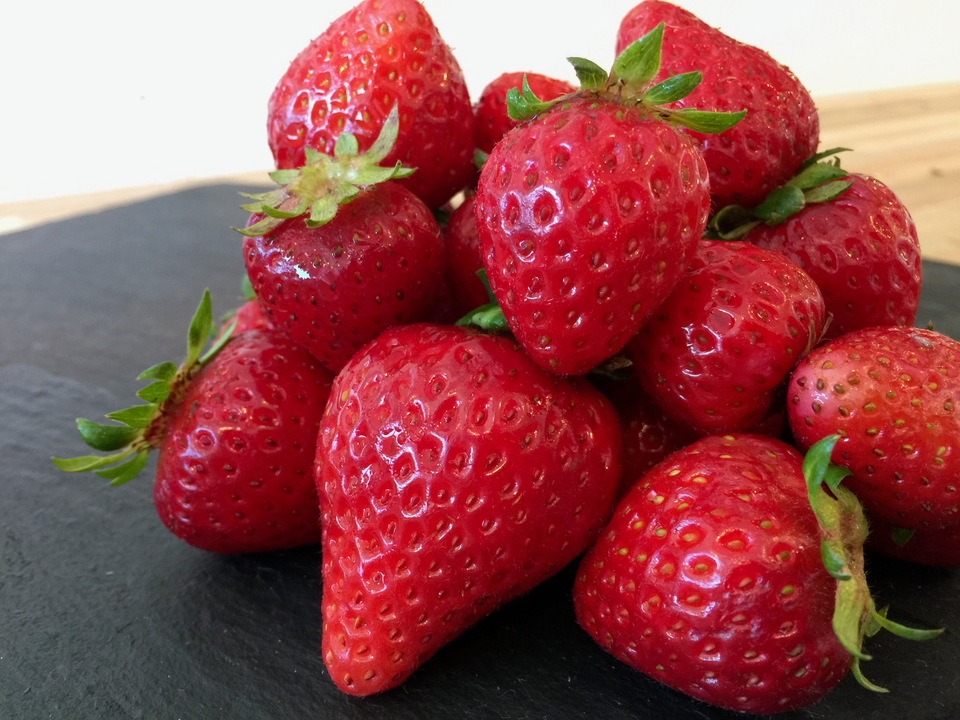
Vertical farming promises perfect berries through engineered control, but tech culture’s obsession with optimization and certainty is ill-suited to the messy, relational realities of growing real food.
Professor Guthman
The Problem with Solutions
10 December 2024
There’s a business concept that I thought was so apt when considering the idea of vertical skyscrapers of strawberries after our quarter-long seminar on The Problem with Solutions with Professor and author Julie Guthman. According to tech blog and analytical product developer VerifiedMetrics, vertical growth is business jargon for sticking with the same customer base, and downplaying other growth strategies such as exploring new industries or gaining more customers. According to these finbros, “Vertical growth makes the most strategic sense when your core business is strong, there are significant opportunities in your existing market, and horizontal expansion is limited. Doubling down on your competitive advantage allows you to maximize the potential in your current market space before attempting to expand into new market segments or geographies” (“The Power of Vertical Growth: How to Scale Your Business by Going Deep”).
The strawberry industry has these characteristics—becoming the best strawberry has been the game since Driscoll’s started, and there are agricultural challenges due to overreliance on pesticides and technological opportunities due to the proximity and overlap of California’s titan twin industries. Plenty is “‘on a mission to sustainably grow fresh food for everyone, everywhere,’ (their) CEO Arama Kukutai said about the company's Virginia investment (in) September (2022).” (Green, 2023, p. 1). According to their website’s About page, their rank and file consists of “scientists, farmers, business people, creatives, and even a few friendly robots” who are helping them apply technology principles, as co-founder and Chief Science Officer Nate Storey puts it, “feed a lot of people, extend lives, fight environmental destabilization, and give land back to the natural landscape” (“About Plenty”).
The website says their company started 10+ years ago at the University of Wyoming. What’s less clear is that it now has its headquarters at the epicenter of the techno-fix world, San Francisco (Green, 2003, p. 1), despite the explainer website boasting about their “farms” in Laramie, Wyoming (“the original”), Compton, California (their “flagship” farm, which they also refer to as a “farming hub”), and now in Richmond, Virginia (their “berry” farm, also proudly called a “campus” due to their grandiose plans for expansive grow buildings that are around three stories high), which is the subject of my analytical investigation to follow.
Their choice of jargon veers from agricultural to industrial because they don’t farm with soil… they farm vertically, indoors, using a method often referred to as Vertical Farming Systems (VFS). The controlled attempt to eschew the natural elements we typically associate with growing food—namely believing that the problem with “traditional outdoor farming” lies in the fact that “the weather, soil, and other factors are less controllable” (Burgos, 2024).
In a news article published by New Atlas, reporter Bronwyn Thompson through intensive studies produced in partnership with “an international team of scientists that see this new phase of agriculture as a way to ease global food demands,” and the group has even had their results published in the journal Frontiers in Science[1] (Thompson, 2024). In the same article, Driscoll’s CEO Soren Bjorn is quoted: “‘By combining our 100 years of farming expertise and proprietary varieties along with Plenty’s cutting-edge technology, we can deliver the same consistent flavor and quality our customers love – now grown locally… This new innovative farm is a powerful step forward in continuing to drive category growth in new ways for our customers and consumers.’” (Thompson, 2024).
The company is stoking the flames of industrial growth with regular media coverage that includes consistent, buzz-word talking points. An article in the Richmond Times-Dispatch from 2023 refers to the new farm site as “expanding cross country from San Francisco to Chesterfield, bringing 300 jobs along with it” (Green, 2023, p. 1). According to another article in the same paper from the year prior, the project is in partnership with strawberry super-producer Driscoll’s, and received a combined $2.9 million in grants and funding from Virginia, advanced with support from the state’s Governor Glenn Youngkin (Ress, 2022, p. 2).
According to Gov. Youngkin, “state officials customized a package of incentives that ties public support to the actual investment and hiring the company does,” and explains how Plenty CEO Kukutai “said the Richmond area has the skilled workforce and nearby colleges that the company will need to find the technicians and plant scientists who will keep robotic planting gear as well as lighting, ventilation, and nutrient feeds operating. They will also make sure produce is picked when it is ripe and ready to be shipped” (Ress, 2022, p. 2). The company openly touts the new campus farm’s proximity to the East Coast and their ravenous appetite for year-round strawberries. This market doubled between 1994 and 2014, primarily due to marketing efforts by the California Strawberry Commission, and was put at risk due to the soil pathogens and toxicity of fumigants required to maintain the strawberry cultivars (“Grow: Pathogens…”, 2019).
According to Plenty co-founder Nate Storey, “Producing food is a good, honest pursuit, but the food system is complex and abstract.” (“About Plenty”). Plenty’s job creation and hiring advertisements have been a strong push in the overall media campaign, which makes sense considering their state funding incentives are tied not only to their capital investment to build the factory but also in part to actually getting people hired on (Ress, 2022, p. 2). According to Plenty’s CEO, Arama Kukutai, they are counting on encountering a skilled workforce in the Chesterfield-Richmond area and multiple local trade and technical colleges. The majority of labor requirements will be to maintain robotic equipment, lighting, nutrient chemistry (and pumped micro-plumbing feeding systems), and ventilation, but who will also be responsible for harvesting the produce at peak ripeness to send to market (Ress, 2022, p. 2).[2]
In a 2023 article, Kukutai made sure to mention employee benefits for the senior management team they were actively recruiting, stating: “‘The scale and sophistication of what we're building here in Virginia will make it possible to economically grow a variety of produce with superior quality and flavor.’” (Green, 2023, p. 1) The article went on to list Plenty’s touted leadership development programs, financial planning workshops, community volunteer programs, DEI, commuter benefits, and “some free meals” as employee benefits when recruiting for their senior management positions… “as well as cost-free mental health services for employees and their families through Spring Health[3].” (Green, 2023, p. 2)
Plenty is benefitting from their scientific team of researchers who obsessively chart the conditions necessary to grow the highest-quality luxe produce possible, and the strawberry is the kingmaker of all luxe produce to the average American consumer. They claim to be utilizing AI technology to maintain full control over the growing environment—temperature, light that “mimics sunlight,” moisture levels, and the nutrient quality of the water, and data-dumped into analytical computations to tell the “cultivators” if the plants need more or less light…. but that is also capable of changing the growing conditions with the help of its AI and robotic features (Burgos, 2024). I find it hilarious that the lede of the designbloom article that touted it is “revolutionary” tech-intensive solution was that Plenty’s proprietary AI VFS “doesn’t rely on traditional outdoor farming because, in that setting, the weather, soil, and other factors are less controllable” (Burgos, 2024).
The research to perfect these obsessive techniques seems like a huge distraction and waste of resources compared to the impressive results that come from becoming loyal customers of thoughtful growers who actively work with natural systems and cycles to cultivate a variety of nutrient-rich, deliciously ripened, and culturally enriching local food varieties. Creating a smaller, well-networked relationship with the food we consume is possibly the most anti-capitalist strategy for removing the middleman from our financial relationship with our basic needs–unless you consider the recently adopted methods of American anti-hero The Adjuster (Haught, 2024).
The methods described by Plenty’s PR team depend heavily on deep learning (Benjamin, 2019, p. 51) to replicate the natural evolution of living systems. They are “removing the unpredictability of Mother Nature and making it possible to grow produce with peak-season flavor, year-round, almost anywhere in the world” (“Plenty opens…[4]”, 2024). Additionally, moving plants into an artificial environment not only smacks of substitutionalism (Guthman, 2024, Ch. 3, “Objects of Disruption”) but also, while we are at it, discredits Mother Nature's good name! Their scientists even wrote in their article that “it removes uncertainty over ‘Genotype × Environment’ interactions that can slow down crop selection in plant breeding” (Kaiser et al., 2024, p. 2). Oh, I’m sorry. Do you mean NATURAL SELECTION?? Bruh.
The journal article went on to explain that the difference between day and night temperatures (DIF) was found to have a huge impact on healthy plant growth, only to conclude that “It is probably more cost-effective to maintain a lower average daily temperature in winter and a higher average daily temperature in summer.” (Kaiser et al., 2024, p. 10), which I would hazard to point out Nature, even more so with climate change, will do just fine all on her own. As Julie Guthman pointed out in her Edible Education discussion, “biodiverse operations have a great number of lively organisms there that control one another, whereas “hydroponics is quite the opposite… like a sterile environment, where you take away all of the possible things that could hurt the plant you are trying to grow and… one little bug gets in, and then you do not have all of the biodiversity to fight that” (“Grow: Pathogens, Chemicals, and the Fragile Future of the Strawberry Industry,” 2019). She points out that significant political, economic, ecological, and scientific challenges must be considered when adapting to a post-fumigant strawberry industry, NOT JUST TECHNICAL (“Grow: Pathogens,” 2019, 56:45), under the misnomer that researching and gaining god-like control over the factors at play in the natural environment upon which agriculture is based can in any way be considered sustainable.
The hubris involved in thinking we can just side-step our way into a laboratory and avoid caretaking the natural environment in responsible ways! Ways ensure our ability to use the land as a sustained resource instead of an extracted one, assuming that such a technological fix could adequately speak in solidarity with the natural environment (Johnston, 2018, p. 53). Their rendering technical (Li, 2007, p. 7) of the environmental degradation we are faced with, technologically “recovered” from intensive agriculture practices into a Dexter’s Laboratory of ultra-fragile cultivars and, as Julie Guthman points out in her 2019 guest lecture for UC Berkeley’s Edible Education course, the potential for novel pathogenic fungi growth—diseases that have already been shown to worsen, ironically enough, when plants push more of their energy into a heavy fruit load, which are exactly the traits that growers have been selecting for (“Grow: Pathogens” 2019, 00:48:30)
Guthman goes on to later discuss how hydroponics, much to the chagrin of organic growers who prize the soil and soil quality to grow in, attempts to redefine what pesticide free means, but “its not really true” … maybe you can grow a strawberry without soil, “but the cost and infrastructure required for hydroponics is tremendous” (“Grow: Pathogens”, 2019, 1:10:55), which shows not only hubris but reeks of trusteeship—aiming to enhance and direct the workforce’s trajectory, and to control it, in addition to the environmental factors at play (Li, 2007, p. 5). By engaging the scientific community and seeking out government funding to invest heavily in their industrial development, Driscoll’s and Plenty are doubling down on the strawberry cultivars first pilfered from government-funded origins into the private sector by Driscoll’s (“Grow: Pathogens”, 2019, 00:22:05), and then again benefitting from the innovation-boosting benefits of working outside of government or regulatory controls (Guthman, 2024, Ch. 1, “A Different Kind of Government Support”).
The fact that this business expansion model is so capitalism-enriched—with it’s exclusive contract for Driscoll’s genetics and marketing rights, and their funding incentives to maintain certain numbers (but unknown quality) of workers—lends me to agree with Guthman’s forecast of VFS in her 2019 Edible Education talk, where she explained that, “hydroponics is, at the very least, highly capitalized, so that’s just gonna squeeze certain growers out” (“Grow: Pathogens”, 2019, 1:12:00). Because the technology systems we develop only amplify our own ignorance to the complex, microscopically diverse, and vastly unknown natural world in which we’ve known to grow food (Guthman, 2024, Ch. 3), I fear they will also enhance the rising levels of bacterial contamination of E. coli and other well-understood and typically well-mitigated harmful microbes, as well as drive further inequities in their operational hierarchies by employing distinct classes of senior engineering professionals and an extracted workforce of “robot and freshness maintenance technicians”.
From a social justice perspective, this is highly concerning, and reeks of the earliest examples of robots, where people are the application of people as tools to operate the computational machines would lead to the return of slavery (Benjamin, 2019, pp. 55-56) and away from the ideas that they purport to engage with, to collectively empower a future with limitless berries delivered fresh every day, and the energy to produce and transport them.
“About Plenty.” Plenty, https://www.plenty.ag/about/. Accessed 7 Dec. 2024.
Benjamin, Ruha. Imagination: A Manifesto. W. W. Norton & Company, 2024.
Burgos, Matthew. “Plenty Opens World’s First Vertical Farm That Uses AI to Grow Strawberries Indoors in Virginia.” Designboom, 26 Sept. 2024, https://www.designboom.com/technology/plenty-worlds-first-vertical-farm-ai-strawberries-indoors-virginia-richmond-09-26-2024/.
DMHC Fines Spring Health Plan $1 Million for Operating Without a State License While Offering Employee Assistance Programs. California Department of Managed Health Care, 8 Nov. 2024, https://www.dmhc.ca.gov/Resources/Newsroom/PressReleases/November8,2024.aspx.
Green, Thad. “Indoor Vertical Farm Being Built in Chesterfield; Plenty Unlimited Bringing Driscoll’s Strawberries, 300 Jobs to Chesterfield with Vertical Farm.” Richmond Times-Dispatch, 01 ed., 3 Sept. 2023, p. 4D.
Grow: Pathogens, Chemicals, and the Fragile Future of the Strawberry Industry. Directed by The Edible Schoolyard Project, 2019. YouTube, https://www.youtube.com/watch?v=bWC69FoZwcA.
Guthman, Julie. The Problem with Solutions: Why Silicon Valley Can’t Hack the Future of Food. University of California Press, 2024.
Haught, J. Staas. “TikTok Users Call Luigi Mangione the Adjuster; What Does It Mean?” NorthJersey.Com, 9 Dec. 2024, https://www.northjersey.com/story/news/2024/12/09/tiktok-users-call-luigi-mangione-the-adjuster-what-does-it-mean-brian-thompson-unitedhealthcare/76873455007/.
Johnston, Sean F. “The Technological Fix as Social Cure-All: Origins and Implications.” IEEE Technology and Society Magazine, vol. 37, no. 1, Mar. 2018, pp. 47–54. DOI.org (Crossref), https://doi.org/10.1109/MTS.2018.2795118.
Kaiser, Elias, et al. “Vertical Farming Goes Dynamic: Optimizing Resource Use Efficiency, Product Quality, and Energy Costs.” Frontiers in Science, vol. 2, Sept. 2024, p. 1411259. DOI.org (Crossref), https://doi.org/10.3389/fsci.2024.1411259.
Li, Tania Murray. The Will to Improve: Governmentality, Development, and the Practice of Politics. Duke University Press, 2007. K10plus ISBN, https://doi.org/10.1515/9780822389781.
“Plenty Opens World’s First Farm to Grow Indoor, Vertically Farmed Berries at Scale.” Plenty, 24 Sept. 2024, https://www.plenty.ag/plenty-opens-worlds-first-farm-to-grow-indoor-vertically-farmed-berries-at-scale/.
Ress, Dave. “Vertical Farm Operation to Open in Chesterfield; California Firm Says It Will Build World’s Largest Vertical Farm in Chesterfield.” Richmond Times-Dispatch, 2nd ed., 15 Sept. 2022, p. 1A.
“The Power of Vertical Growth: How to Scale Your Business by Going Deep.” VerifiedMetrics, https://www.verifiedmetrics.com/blog/vertical-growth. Accessed 7 Dec. 2024.
Thompson, Bronwyn. “‘World-First’ Indoor Vertical Farm to Produce 4M Pounds of Berries a Year.” New Atlas, 25 Sept. 2024, https://newatlas.com/manufacturing/world-first-vertical-strawberry-farm-plenty/.
Paul Gauthier, one of the published authors on the research findings, was also interviewed by Thompson, who links to the journal article. The authors all declare that their research “was conducted in the absence of any commercial or financial relationships” which might be a considered a conflict of interest, and also note that eleven of the 22 authors, including Paul Gauthier (PG), were also on the editorial board for the same journal in which their research was published. (Kaiser et al., 2024, p. 19) ↩︎
As a whole, the company doesn’t mention or seem concerned with the santization requirements that are a near-obsessive part of many other high-density hydroponic gardening systems, which I find odd. ↩︎
Spring is a startup mental health provider network that admitted fault and received a $1 million fine just last month from the Department of Managed Health Care (DMHC) in Plenty’s home state of California. The charges included “offering health care services in California without a license.” According to a November 2024 DMHC press release, “Spring Health illegally operated as an unlicensed health care service plan, offering Employee Assistance Program (EAP) services to upwards of 370,000 California-based employees. ... Spring Health was operating as an unlicensed plan by arranging for member care with network providers while collecting a prepaid or periodic charge. ... Spring Health acknowledged their failure to comply with the law and agreed to pay the $1 million penalty. In addition, Spring Health worked with the DMHC to get licensed so they can continue providing health care services” (“DMHC Fines Spring Health Plan $1 Million for Operating Without a State License While Offering Employee Assistance Programs”, 2024) ↩︎
full title is “Plenty opens world's first farm to grow indoor, vertically farmed berries at scale” ↩︎
My inner dichotomy between an ecological, land-based lifestyle and my relationship with technology were deeply at play as I ideated and executed this interactive coding project.
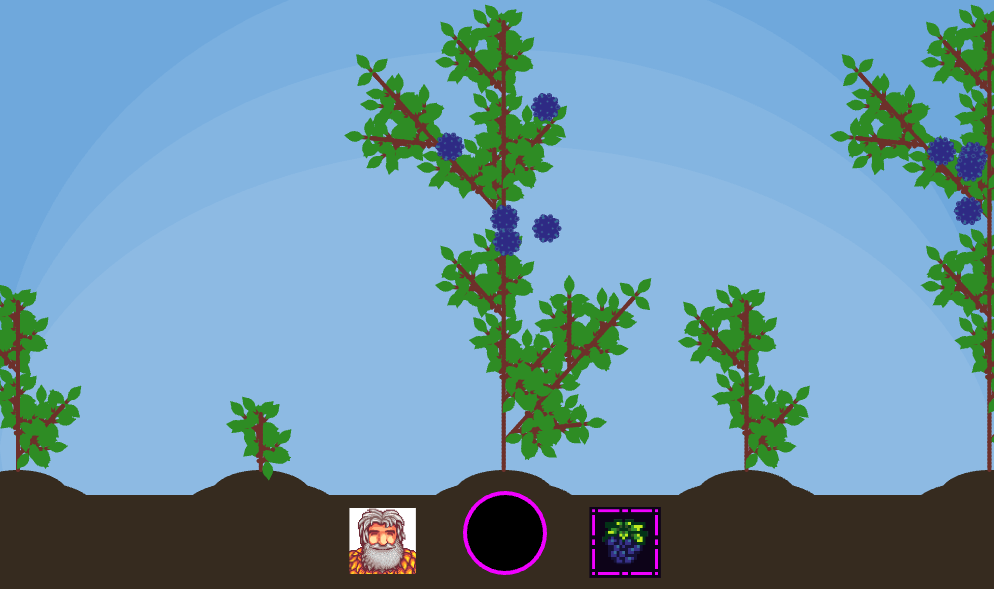
My inner dichotomy between an ecological, land-based lifestyle and my relationship with technology was deeply at play as I ideated and executed this interactive coding project. There was something this project unearthed in me about an experience I had several years ago, when one of my best friends was attending UCSC for Mathematics, and I was overseeing regular rotations of WWOOFing1 visitors on a farm a bit farther up the Coast near Half Moon Bay. She was coming to stay while groups of WWOOFers, and I had two long rows of clay soil to dig up and plant the blackberry canes that had just arrived by mail, before she was due to arrive.
I dug the rows, planted the berries, and was sore and happy by the time she arrived for a weekend of catching up and cooking good food together. We had a marvelous time, in large part because of the dearth of technology that was available to us down in Lobitos. My only responsibility to those berry canes during her visit was to untangle the garden hose and keep them well-watered until the next rain, while she visited the horses and ponies in the pasture. I was eager to get back to our visit, and had to calm that part of me that wanted to rush through the watering-in of my new plant friends. I turned untangling that 200 feet of hose into a meditation, and reminded myself that this was the one thing that I was meant to be doing in that moment; my attention to the task would only make the job easier and lessen my frustrations of wanting to be done with it already. “The only way out, is through.”
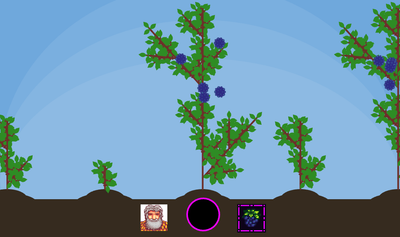
Knowing what a challenge this project might entail of myself, that memory of caretaking those new plants brought me back to a peaceful but keen to take on the coding endeavor. I started with a single leaf—three leaflets on a stem, that I knew I could easily tackle and would provide a functional element to my later work “growing” the plants in digital form. Next, I coded a number of planting rows, digital mounds of dirt that would each have their own berry plant emerge with the correct and repeated application of water to fuel each growth stage.
I was frustrated by the idea of relaying the smooth, iterative ways that plants in general grew, but was doubly unsure about incorporating my horticultural knowledge and keeping the berry plants honest to their taxonomic growth pattern. I remember sitting on campus one day and scouring the Internet for ways I could represent plant growth in p5.js, and legitimately jumped out of my chair with excitement when I found a video (and more importantly, a three-part series that led up to) a tutorial on coding L-systems and incorporating linear interpolation (or, as Barney Codes referred to it, to ‘Lerp’) an animation procedural plant growth.
As excited as I was to follow his tutorials and then apply the coding terminology to my project, I ran into a bigger issue… the singular plant at the center of my project was glitching with both the auto-reversion code Barney had baked into the tutorial I modeled it off of, and due to the randomness and branching pattern he incorporated. Considering his original plant had looked more like a single branch of wild carrot, when I added my trifoliate blackberry leaves to each branch end they looked more like bush beans!
I couldn’t get the plants to “sit, stay” long enough to incorporate my life lesson on watering and patience into the animation! Luckily, I was able to troubleshoot this with some incredibly geeky friends who are (mostly professionally) programmers of one flavor or another, and they were also able to point me in the right direction to tweak the compound berries of layered ellipses, so eventually they looked representative enough of a blackberry that I wanted to eat them!
This experience caused my rather insular self to understand Professor Moreno’s words at the start of the quarter: coding was a collaborative effort. I knew these guys were wizards who could run complicated Excel formulae off-the-cuff and under pressure just because I mentioned it would make my work on the team just a little bit easier. That day, though, I saw firsthand how a “many heads are better than one” approach is vital to both debugging and natural systems. Large-scale coding projects—just like land stewardship—depend on collective effort to thrive.
Now that I had my plants growing smoothly, I took on the challenge of that tangle of a water hose… this time, though, the job was to create multiple plants, each on their own mound and Lerp schedule, and responsive to the correct placement of water at the appropriate time to grow an iterative amount. I was able to tweak the stages of growth to fit the frame and stay interesting in its game play experience. Next, I programmed in to grow my “Blackberry” function initially to look similar to a blackberry blossom, then “ripen” through the Lerp color palette.
It was around this time that I went back to check in on the “lore” behind the images I had sourced for this project. I chose the blackberries because they looked similar to the ones I coded, and Linus came along for the ride when I found an image of gameplay dialogue, where Linus expressed appreciation for the player returning his basket. I had never played it and wasn’t acquainted, but his character reminded me deeply of one of my neighbors at the Lobitos farm, who wasn’t quite homeless but loved living closely to the land and whose somewhat gruff personality thrived with having minimal economic interdependence with the townsfolk of Half Moon Bay. I appreciated how Stardew Valley players responded to Linus with warmth and generosity, echoing my belief in the value of food-sharing and respecting alternative ways of living. I incorporated a “Linus lore” button as an homage to that sentiment.
Ultimately, I was proud that this project, built from simple coding functions, became an immersive, almost meditative experience for the player. I was delighted that classmates found the game engaging, and, perhaps most tellingly, I still wanted to play it myself—even after countless hours of troubleshooting and fine-tuning.
That realization was profound. A few years ago, I left traditional farming behind, partially due to Long-COVID’s impact on my health and my inability to be as active as farming required. Through this digital blackberry patch, I’ve begun to stitch together my past and future—melding the hands-on wisdom of land stewardship with new creative possibilities in digital storytelling.
I’m excited to continue developing as a Creative Technologist inspired by the works of Aldo Leopold, Rachel Carson, and Gary Snyder. My goal is to use storytelling and interactive media to preserve and expand upon the environmental awareness that thinkers like Snyder have championed. The Environmental Protection Agency was formed largely due to the alarming reality that Silent Spring presented to the world; I hope to contribute to that lineage—not just through direct environmental work, but by using digital tools to reconnect people with nature and foster a reverence for the Earth House Hold we all share.
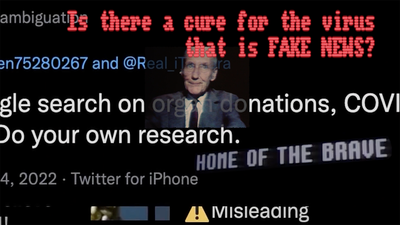
An artistic exploration of the long, entwined histories of misinformation and vaccine hesitancy, and their contemporary implications.
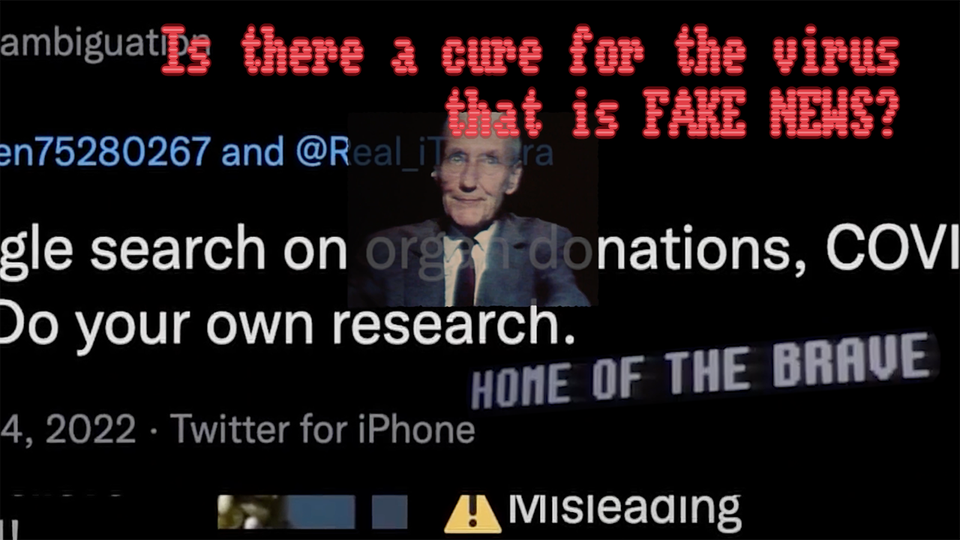
Prompted by the first project scope Prof. Bueno presented to our cohort—to create a video montage based on the prompt "A Sea of Data"—my inspiration came in large part from Edward R. Murrow's fierce stance against McCarthyism in the 1950s, in addition to Sebastião Salgado's humanitarian-focused photojournalistic work. In particular for this avenue of exploration, I ruminated on Salgado's documentation of the Global Polio Eradication Initiative, which began in 1988 and later culminated in his 2003 book, The End of Polio: A Global Effort to Eradicate a Disease.
I was interested in utilizing this video montage project to inquire further into the impact of misinformation ('fake news') and its correlation to the distrust and snake-oil salesman techniques that have amplified the anti-vax movement, more formally referred to as vaccine hesitancy. Both of these issues have extensive histories, though they have gained more significant influence through American public health policy, neoliberal economic incentives, and the capacity for self-publication on digital platforms over the last fifty years. This has resulted in a widespread impact on the contemporary experiences of most people living in the United States.
Previously, self-published misinformation campaigns had to be distributed by hand via pamphlets and photocopied booklets. Digital information spreads fast, and as people gain followers, their ideas become "truthier"—even if they do not have a factual basis.
The online Sea of Data has become overwhelming as the Internet has exploded in capacity and algorithmic control over our attention, directly impacting how we consume information and deem sources credible. Today, it seems incredibly difficult for many Americans, generationally harmed by inequities and with an understandable distrust in government, medical professionals, and the media writ large, to process information and decide what to believe.
When this representation is unavailable, misinformation can spread even more easily, much like disease does when communities are not adequately vaccinated. We need to develop herd immunity against misinformation, and I'm curious how we might make this happen.
While the 'talking heads' that I chose to use in this video are themselves categorically straight-presenting, white, educated men—with the exception of avant-garde musician Laurie Anderson—this only goes to illustrate the problem of an existing lack of diverse representation. I hope this video montage will help others develop their own curious and desirous stance, leading them to explore the truth value, credibility standards, and humanitarian impact of their language and decision-making process, within their own hearts and on their communities, as I have begun to do in mine.
in order of first appearance
"Willam S. Burroughs on SNL", 2019 by @bighollywoodproducer
https://www.youtube.com/watch?v=aTl6xVMbJ6Y
"Cut-Ups William S. Burroughs", 2011, by @QUEDEAR
https://www.youtube.com/watch?v=Rc2yU7OUMcI
"William Burroughs, The Word Is an Organism", 2016, by @Kunstradio
https://www.youtube.com/watch?v=YNxLuC5A5Mg
"Disinformation Abounds in the Wellness Community. How One Anti-Vax Influencer Broke Free", 2022, by @PBSNewsHour
https://www.youtube.com/watch?v=dDn77Qykgy4
"Could You Patent the Sun?", 2013, by @GLBLCTZN
https://www.youtube.com/watch?v=erHXKP386Nk
"The Vaccine for Fake News, 2021", @cambridgeuniversity
https://www.youtube.com/watch?v=Jqt7B857ooM
"Kurt Andersen: A 7 Min History of American Fake News (Telling the Truth Journalism Symposium)", 2017 , by @NYSWritersInstitute
https://www.youtube.com/watch?v=FD4QdTBxuHM
"Researching the Spread of Fake News and Its Impact", 2018, @CBCTheNational
https://www.youtube.com/watch?v=K5iBW2KGZfQ
"WORD IS VIRUS - WILLIAM S BURROUGHS and GUS VAN SANT", 2014, by @cakeworm1200
https://www.youtube.com/watch?v=yqukFWVCt04
"Is Language a Virus?", 2011, by @ArtistictheotherAI
https://www.youtube.com/watch?v=8-kzRSQZZ1w
"Laurie Anderson - Language Is a Virus (Official Music Video)", 2024, by @nonesuchrecords
https://www.youtube.com/watch?v=1eTSL2kopP4
This soundmapping project invites listeners and visitors to experience a coastal bluff through the shifting textures of its acoustic life.

Visit the Sound-uMap directly at http://u.osmfr.org/m/1221587/
The Polyglot Open Space Tour is a place-based exploration of Wavecrest Open Space, a coastal preserve on the edge of Half Moon Bay, California.
This project began with a simple question: How many ways can a place speak? My title references Bruce Albert's "The polyglot forest," in which Albert describes the forest not as a singular voice but as a cacophony of languages, resonances, and ecological identities. The title "Polyglot Open Space Tour" also honors the Peninsula Open Space Trust (POST), which purchased the land in 2008 to protect its wetlands and coastal prairies from contentious local politics and impending residential development.
The cypress windrows and coastal chaparral offer a layered conversation between birds, shoreline, weather, humans, and the dogs who enjoy this space. For those willing to quiet themselves long enough to listen, the land speaks to us through its ecoacoustics.
The Peninsula Open Space Trust – Wavecrest, Blufftop Coastal Park and Poplar Beach birdsong audio libraries by eBird also inspired this sound mapping project. Developed and run by the Cornell Lab of Ornithology, eBird is a global platform where birdwatchers review regional species data and contribute their own photos and audio recordings tied to specific birding "hotspots," thereby participating in a worldwide biodiversity study.
To me, eBird also acts as a sort of poetic ledger, revealing why Wavecrest—and open spaces like it—deserve both protection and recognition for their biodiverse habitats and wildlife corridors, as well as their recreational value. The Wavecrest eBird archive became the "third leg" of inspiration for the Polyglot Open Space Tour, which expands beyond the birdsong to include a cohesive acoustic identity of the landscape.
In developing the interactive interface, the Monarch Waystation Soundmap by Alejandro Botilo gave me a valuable framework to understand my end vision. In time, I look forward to adding experiential sound pieces like those featured on Botijo's Soundmap, which layer multiple field recordings and musical performances captured within a given proximity along the Western Monarch's migratory routes.
I curated a "starter pack" of audio clips from my archive of video files and some recent field recordings from my visits to Wavecrest. Through this project, I aim to collect samples of Wavecrest's overarching acoustic experience within a mapped geotagging interface, allowing me and my fellow ecoacoustic explorers to curate and remix hyper-local sound samples into artistic expressions of soundscape ecology. As the project grows, I like the idea of developing soundscapes that can follow an intended path of travel, remixing and playing in sequence as the user navigates the trails.
I welcome visitors to contribute their own recordings and points of interest to the project, capturing a specific sound, photo, or moment that speaks to this place's identity and our collective experience of Wavecrest.
This will allow the map, as a whole, to iterate into a shared acoustic archive, eventually reflecting our shared appreciation for Wavecrest and the access to nature that it provides. Artistic Remix audio submissions—those that have been layered and/or inspired by a spot at Wavecrest or Blufftop Park—are also welcome and encouraged!

This project was created using uMap (OpenStreetMap) and is part of an emerging exploration of creative cartography, place-based storytelling, and soundscape ecology.
Poison Oak is a drag-inflected interpretive persona I created to discuss plants, wildfire, and environmental justice without being dismissed as “woo” or nostalgia. The character aims to reframe eco-monsters as neighbors who can teach us about boundaries, care, and accountability in the Anthropocene.
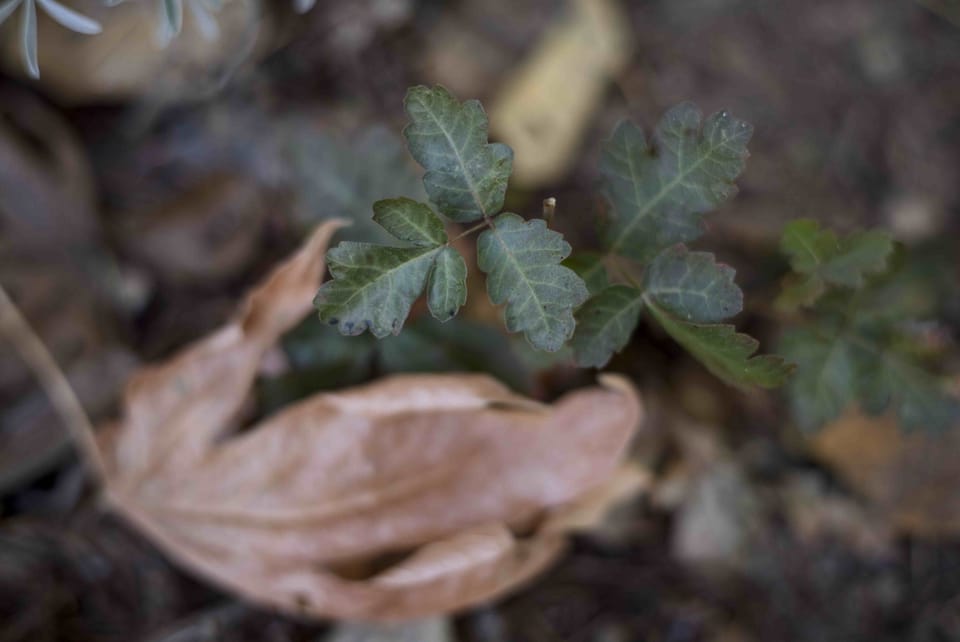
My aim in creating the persona of “Poison Oak” was to identify the character traits and advocacy relationship of a drag character who, in the great tradition of other characters that have held this space, could provide a ‘skin’ from which I might be able to enter a world of respected and thought-provoking social/ethnobotany/magickal world edutainment voices. Across my lifetime, I’ve been inspired by Ms. Frizzle (The Magic School Bus), Joey Santore (Crime Pays But Botany Doesn’t), Pattie Gonia, Jinkx Monsoon (both drag artists), and Beat Movement authors such as Diane Di Prima, Rachel Carson, Gary Snyder, Bob Kaufman. I wanted to create a character that gave me a way of talking about “hippie” concepts without being dismissed as a Polly Anna stoner—topics like treating plants, animals, and landforms as part of our communities, de-monsterifying real-world bad actors in order to dismiss them from accountability, and understanding “garden therapy” lessons.
I spent a year helping develop and run an eco-therapeutic inpatient treatment center for eating disorders, and went on to gain a horticulture degree where I focused on “listening” to the garden I was tending. It can teach us much about how to interact with other humans, animals, and wild spaces as a whole: recognizing and meeting the needs of others outside of our own expectations and time table, identifying and responding to non-verbal communication cues to better care for those we share space with, and understanding the larger systems at play that bring our collective environment into harmony—or a poisonous, toxic, or fear-inducing space, like UCSC Prof. Lindsey Dillon writes about in Toxic City: redevelopment and environmental justice in San Francisco. Whether urban or rural, we all share spaces with non-human entities that we vilify and turn into our enemies, and I wanted to provide an interpretive voice, with a deadpan sassy flair, to that message.
I found it very compelling to finally write a sort of “introduction video” as this character who I’ve been considering for so many years. Being able to explain some of the natural plants (the Anacardiaceae family, which includes mangoes, poison ivy, and poison oak) and environmental processes (wildfire, water tables) as this character has helped me consider how to “become” the Ms. Frizzle environmental interpretation voice that I’ve held dormant within myself. It was almost like it was a wildfire-activated seed that sprung into life having the opportunity to take root, get some sunshine on them, and blossom into an actual project.
I’ve been hesitant to practice the “activist + artist” courage that requires confidently speaking on these topics, but was pleasantly surprised at how I was able to take some shaky first steps towards “building a relationship” with a (virtual, non-existent, build-it-and-they-will-come) audience for my discursive little diatribes. I did a couple of rehearsal/edit read-throughs of the script but didn’t edit anything from the video after, and definitely feel like I could improve on tone and delivery to make the message I’m conveying a bit more … palatable, but generally was happy with letting the “rough draft/endosperm” version of my characterized self out into this big, scary world. I really hope that together, the character and world can soften and become a little bit more charming together through building a community of humans who want to do better by each other and the inhabitants who can’t speak up for themselves, except by burning us when we overstep on their boundaries.
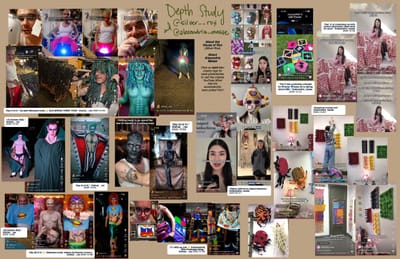
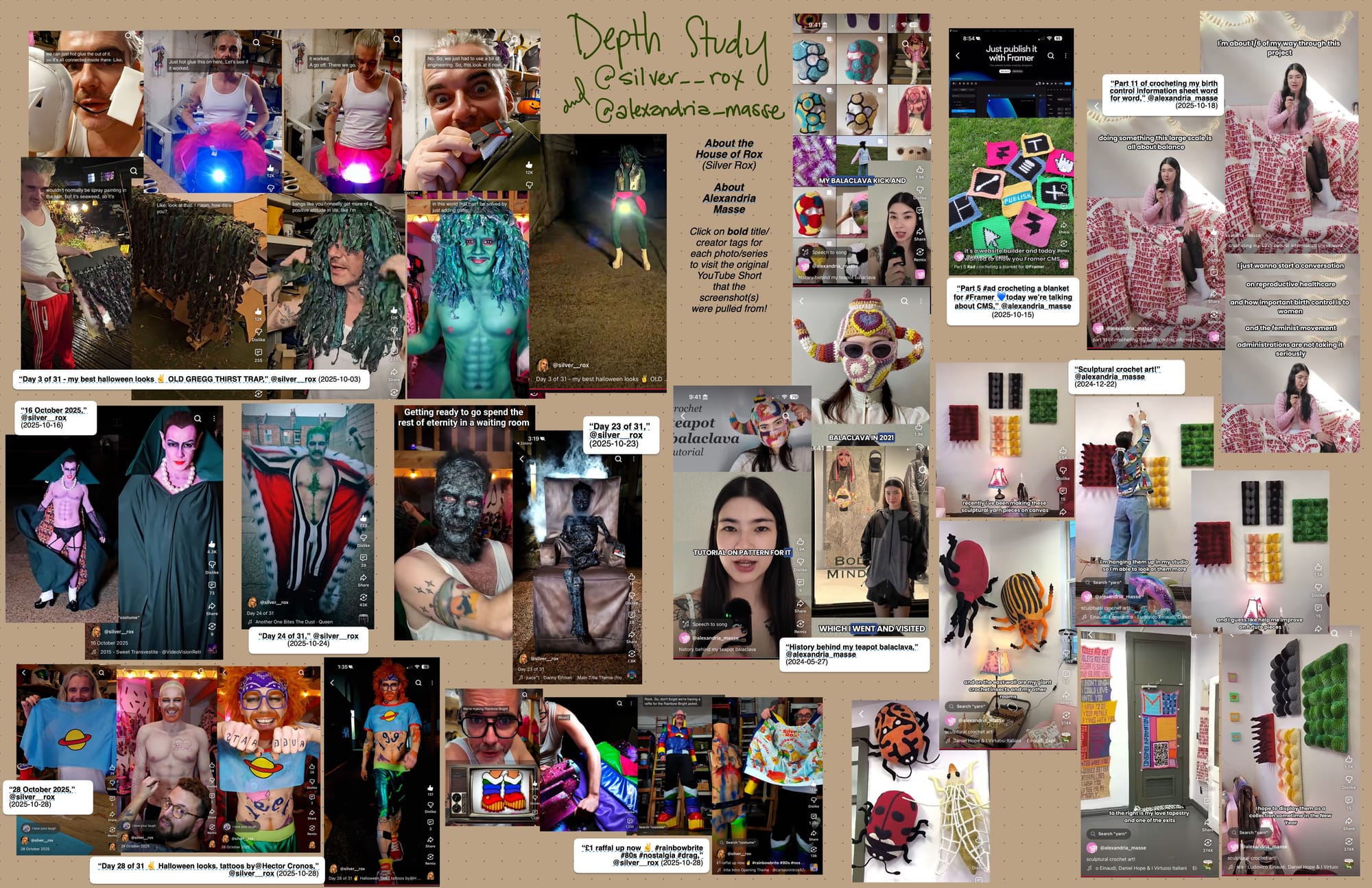
A collage contrasting two contemporary artists and how they each explore a subversive creative practice through analog crafts and digital content creation.
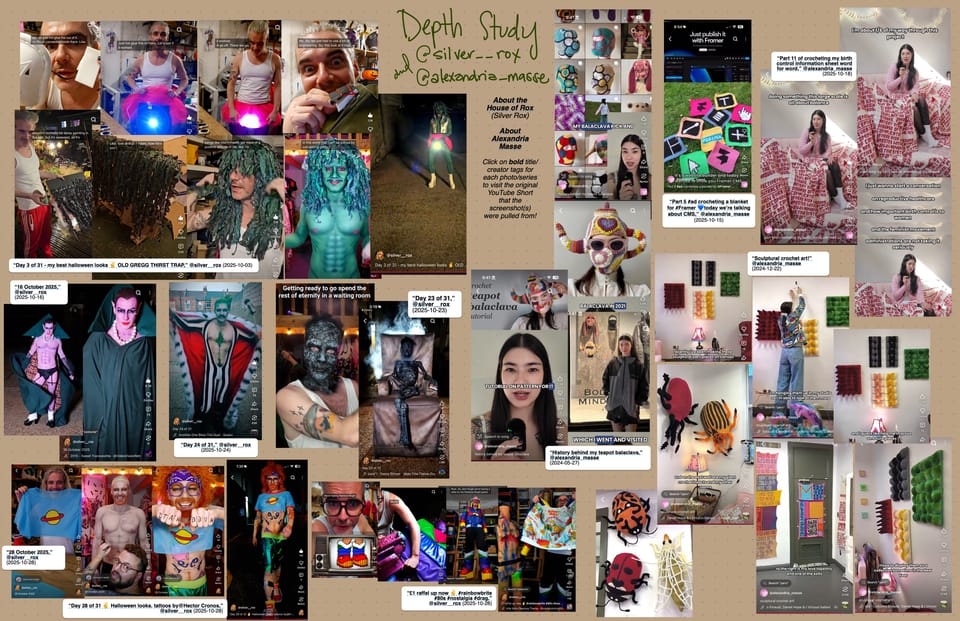
I find it interesting that SilverRox works in a collaborative space (he has a warehouse studio with his twin brother and two other artists), and that Alexandria Masse seems to work primarily from her home in a solo practice.
Both have found ways to monetize their art, probably through content creation/AdSense, as well as by selling some version of their work.
There are obvious methods—Rox runs a sort of raffle for custom recreations of some of his pieces (like the Rainbow Brite leather jacket at bottom center), and Masse partnered with Framer to crochet recognizable icons from their app and discuss topics relevant to their customer base. They both have some aspect of social justice aims in their work, too—Masse works on her birth control info sheet crochet project every time she has a menstrual cycle, while Rox creates drag art that celebrates queer identity.
I was intrigued by the idea of exploring how artists from around the Western world are sharing their work online to build creative, dynamic portfolios while exposing new viewers to their work. Neither "push" people to engage with their artistic work off the platform(s), but Masse did create a crochet pattern for her teapot balaclava, and Rox runs workshops that teach people some of his techniques (the "how to foil a leather jacket" workshop seems like it is quite popular).
While they're very different in style, personality, and artistic mediums, both Masse and Rox are incredibly skilled at presenting their work and artistic personas online, and bring me a lot of joy to encounter their content. I don't crochet, and while I used to sew a lot of my own clothing, I currently only dabble and dream in costume design and drag artistry. It really shows how a wide variety of artistic perspectives can inspire our own creativity, even in totally different mediums and styles.
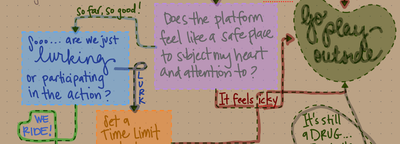
An exploration of what it means to be present online, and how I choose to show up in those spaces.
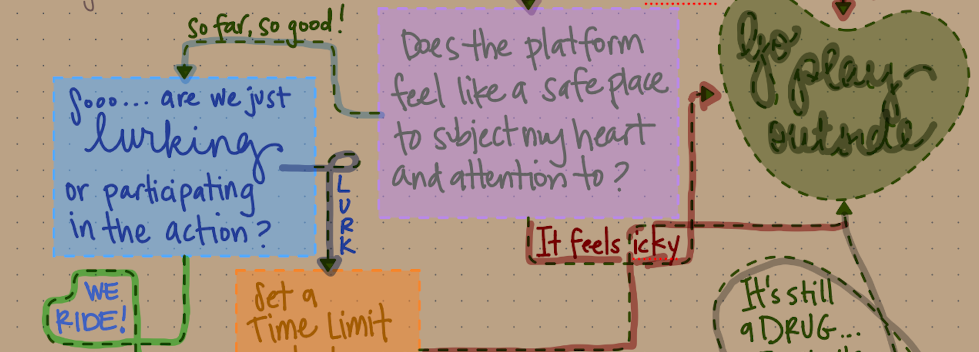
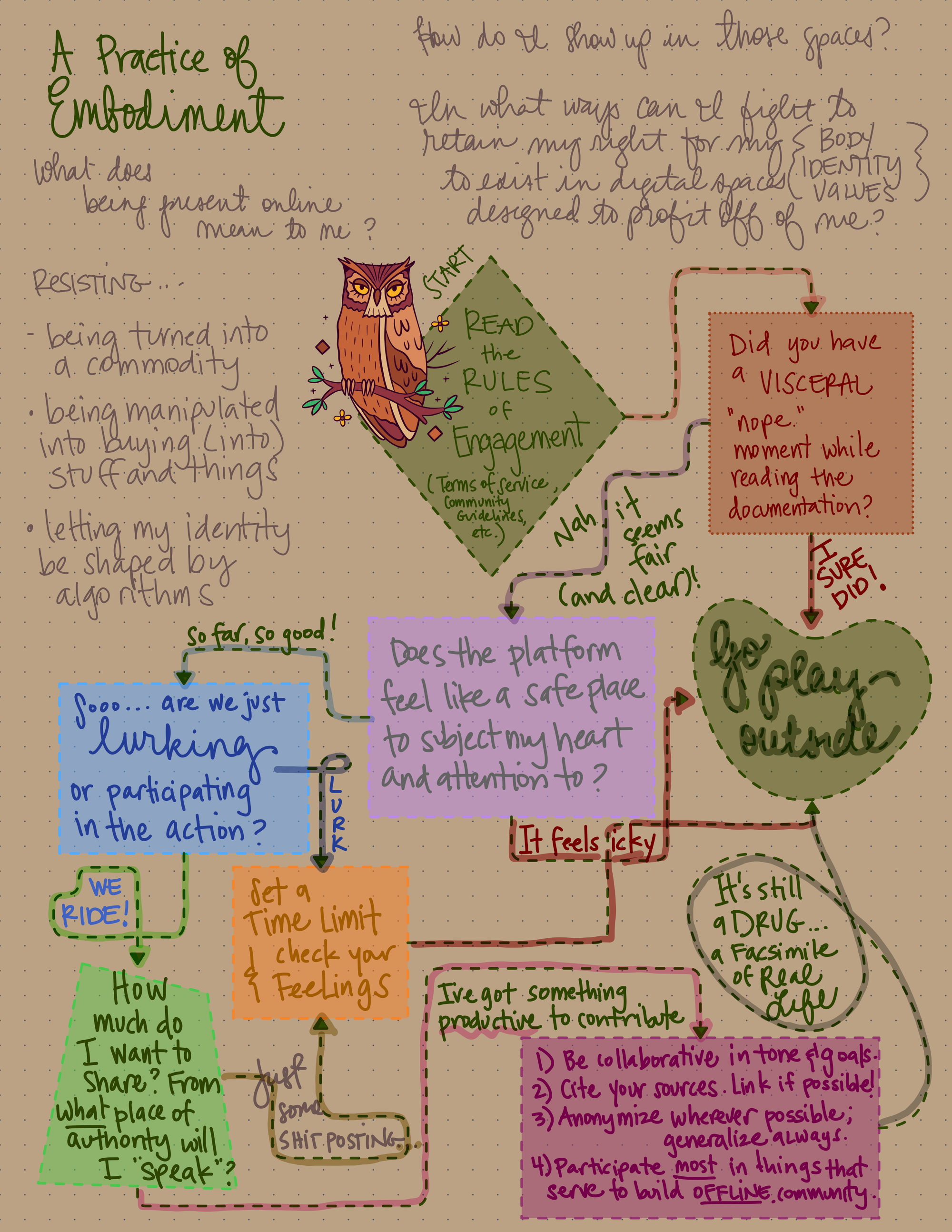
I spend a lot of time thinking about all of the ways the Internet COULD have been.
It could have been a tool to reduce the paper waste of mailed correspondence. To assist with financial and time management to make our lives more seamless and enjoyable. It could have been durable, both in terms of the software and hardware required to participate in its network.
Somehow, the idea of being “hands-free” and “wireless” took over all of its potential. Instead of serving as a point of connection, it has become a place where we can tear away all the tethers to the real world, isolate ruthlessly, and suck up toxic sludge of opinions and marketing designed to keep us weak, disconnected, and feeling utterly powerless. We’re powerless to step away from it, powerless to form a rational opinion with a strong basis in theory and experience, and powerless to find other people (and plants, and animals, and natural spaces) to connect with that aren’t also tainted by the 5G (or, Dog forbid, Star-linked) connection to all the world’s information.
We’ve begun to identify our internal battery more with that of our devices and not of our somatics. It’s sometimes hard to even understand how we feel, even though our access to social media “produced” content and the nefarious algorithms that drive our internal landscape have those feelings ratcheted up to 11 from mere moments after we wake up.
I personally have struggled with the drive to be online, to consume media in its various forms, even when it was haltingly slow or, for long stretches of time, intentionally throttled. I lived in the “sticks” of the Santa Cruz Mountains, specifically in Lobitos, with a scratchy landline phone and no cell service for me or the other fourteen households across the ridgeline. There was no Starlink then, but the farm ran off of HughesNet satellite service. We were lucky that the house was high enough up that we could watch the fog creep across the valley floor, and only when the weather really socked us in did our service slow from a trickle to more resemble the drippy fog between the dish atop our barn and the satellite in the sky. There was a strict limit for the amount of data each customer could use per day (around 500MB, if I remember correctly) in order to “ration” the bandwidth across all customers’ demand, and one visit to Facebook by our unsuspecting WWOOFing[1] interns could render our email applications useless until the next day.
Overnight, the plan had several hours that were exempt from these restrictions, starting around 2 AM. It was intended to make downloading larger files and computer updates possible. However, I would often go to bed early only to wake up and watch Netflix or other streaming services. Still with long periods paused to cache a couple of scenes at the lowest available resolution at a time, unless the skies were totally clear. It was detrimental to my sleep, to my busy 90-hour-weeks working on the farm and in the local schools through AmeriCorps, and was absolutely one of the earliest signs that I had inhibition control and executive functioning issues that would later be consistent with a pretty severe case of ADHD.
What I also learned from my days on this farm, and later others, was that community and working together towards meaningful goals with my neighbors and friends felt even better than the methadone version provided by social media platforms. Having game nights with the WWOOFers and cooking dinners with my “farm mama” while we listened to CDs and she told me stories about her wild life and wacky friends… these were the memories I held onto, and wanted to make more of.
My goal for how I want to use the internet and digital devices in general has become “to make being IRL better.” I enjoy participating in forums and comment threads, but moreso when I’m contributing meaningfully and not just “shitposting” with my Duck Hunt-esque combo of sass and fast typing (SORRY ABOUT ALL THE BACKCHAT IN CLASS, I STG I’m trying to apply this theory Every Dang Day.)
I know I read contracts for a living. Still, I do really want to be[2] one of those nerds that actively engages with the Terms of Service and Community Guidelines, and then meaningfully rank both HOW they are written and WHAT they actually say mean a community is one I might feel is even safe to participate in (“x” = 0, 0).
From there, I do try to check in and decide how I want to show up for others online. I am nice, generally collaborative, and try to speak only on things I have background and experience in. (Now, if only journalism were still practiced by those same rules!) I am typically very mindful about anonymizing myself online and consistently focused on building others up rather than tearing people down for their own ways of interacting. How to lure us all outside and put the brakes on our doomscrolling, though… that part I am starting to wonder if I’ll ever figure out.
WWOOF: World-Wide Opportunities on Organic Farms, a sort of VRBO-meets-DoorDash arrangement where people interested in growing food could trade room and board on a farm in exchange for a set number of hours doing work per day or week. ↩︎
A little ashamed that this is still not something I’ve tackled, but OMG it’s like they are written to DISSUADE the practice… ↩︎