p5.js Blackberry Harvest
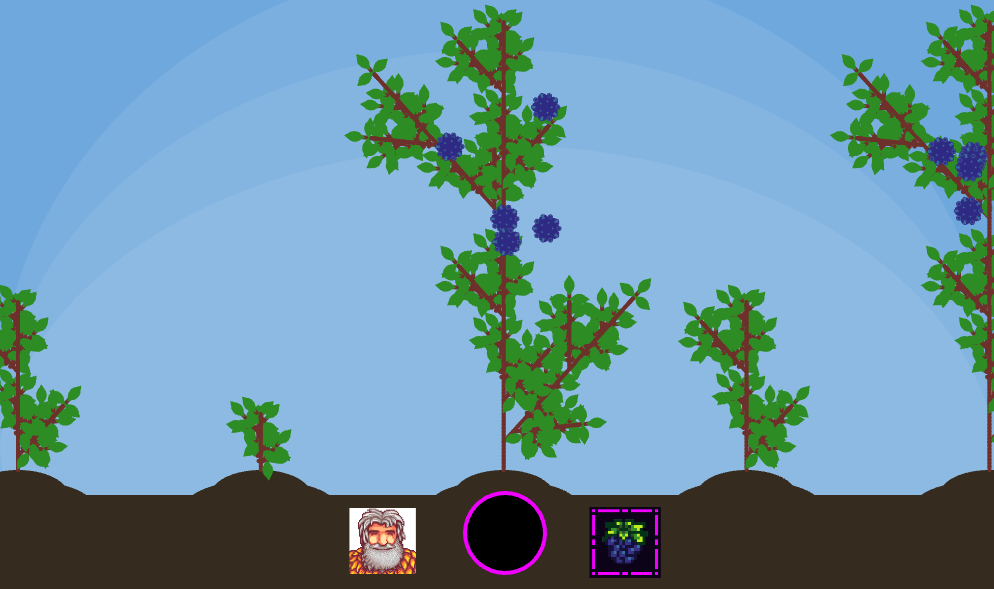
Project Statement: Blackberry Harvest
My inner dichotomy between an ecological, land-based lifestyle and my relationship with technology was deeply at play as I ideated and executed this interactive coding project. There was something this project unearthed in me about an experience I had several years ago, when one of my best friends was attending UCSC for Mathematics, and I was overseeing regular rotations of WWOOFing1 visitors on a farm a bit farther up the Coast near Half Moon Bay. She was coming to stay while groups of WWOOFers, and I had two long rows of clay soil to dig up and plant the blackberry canes that had just arrived by mail, before she was due to arrive.
I dug the rows, planted the berries, and was sore and happy by the time she arrived for a weekend of catching up and cooking good food together. We had a marvelous time, in large part because of the dearth of technology that was available to us down in Lobitos. My only responsibility to those berry canes during her visit was to untangle the garden hose and keep them well-watered until the next rain, while she visited the horses and ponies in the pasture. I was eager to get back to our visit, and had to calm that part of me that wanted to rush through the watering-in of my new plant friends. I turned untangling that 200 feet of hose into a meditation, and reminded myself that this was the one thing that I was meant to be doing in that moment; my attention to the task would only make the job easier and lessen my frustrations of wanting to be done with it already. “The only way out, is through.”
Knowing what a challenge this project might entail of myself, that memory of caretaking those new plants brought me back to a peaceful but keen to take on the coding endeavor. I started with a single leaf—three leaflets on a stem, that I knew I could easily tackle and would provide a functional element to my later work “growing” the plants in digital form. Next, I coded a number of planting rows, digital mounds of dirt that would each have their own berry plant emerge with the correct and repeated application of water to fuel each growth stage.
I was frustrated by the idea of relaying the smooth, iterative ways that plants in general grew, but was doubly unsure about incorporating my horticultural knowledge and keeping the berry plants honest to their taxonomic growth pattern. I remember sitting on campus one day and scouring the Internet for ways I could represent plant growth in p5.js, and legitimately jumped out of my chair with excitement when I found a video (and more importantly, a three-part series that led up to) a tutorial on coding L-systems and incorporating linear interpolation (or, as Barney Codes referred to it, to ‘Lerp’) an animation procedural plant growth.
As excited as I was to follow his tutorials and then apply the coding terminology to my project, I ran into a bigger issue… the singular plant at the center of my project was glitching with both the auto-reversion code Barney had baked into the tutorial I modeled it off of, and due to the randomness and branching pattern he incorporated. Considering his original plant had looked more like a single branch of wild carrot, when I added my trifoliate blackberry leaves to each branch end they looked more like bush beans!
I couldn’t get the plants to “sit, stay” long enough to incorporate my life lesson on watering and patience into the animation! Luckily, I was able to troubleshoot this with some incredibly geeky friends who are (mostly professionally) programmers of one flavor or another, and they were also able to point me in the right direction to tweak the compound berries of layered ellipses, so eventually they looked representative enough of a blackberry that I wanted to eat them!
This experience caused my rather insular self to understand Professor Moreno’s words at the start of the quarter: coding was a collaborative effort. I knew these guys were wizards who could run complicated Excel formulae off-the-cuff and under pressure just because I mentioned it would make my work on the team just a little bit easier. That day, though, I saw firsthand how a “many heads are better than one” approach is vital to both debugging and natural systems. Large-scale coding projects—just like land stewardship—depend on collective effort to thrive.
Now that I had my plants growing smoothly, I took on the challenge of that tangle of a water hose… this time, though, the job was to create multiple plants, each on their own mound and Lerp schedule, and responsive to the correct placement of water at the appropriate time to grow an iterative amount. I was able to tweak the stages of growth to fit the frame and stay interesting in its game play experience. Next, I programmed in to grow my “Blackberry” function initially to look similar to a blackberry blossom, then “ripen” through the Lerp color palette.
It was around this time that I went back to check in on the “lore” behind the images I had sourced for this project. I chose the blackberries because they looked similar to the ones I coded, and Linus came along for the ride when I found an image of gameplay dialogue, where Linus expressed appreciation for the player returning his basket. I had never played it and wasn’t acquainted, but his character reminded me deeply of one of my neighbors at the Lobitos farm, who wasn’t quite homeless but loved living closely to the land and whose somewhat gruff personality thrived with having minimal economic interdependence with the townsfolk of Half Moon Bay. I appreciated how Stardew Valley players responded to Linus with warmth and generosity, echoing my belief in the value of food-sharing and respecting alternative ways of living. I incorporated a “Linus lore” button as an homage to that sentiment.
Ultimately, I was proud that this project, built from simple coding functions, became an immersive, almost meditative experience for the player. I was delighted that classmates found the game engaging, and, perhaps most tellingly, I still wanted to play it myself—even after countless hours of troubleshooting and fine-tuning.
That realization was profound. A few years ago, I left traditional farming behind, partially due to Long-COVID’s impact on my health and my inability to be as active as farming required. Through this digital blackberry patch, I’ve begun to stitch together my past and future—melding the hands-on wisdom of land stewardship with new creative possibilities in digital storytelling.
I’m excited to continue developing as a Creative Technologist inspired by the works of Aldo Leopold, Rachel Carson, and Gary Snyder. My goal is to use storytelling and interactive media to preserve and expand upon the environmental awareness that thinkers like Snyder have championed. The Environmental Protection Agency was formed largely due to the alarming reality that Silent Spring presented to the world; I hope to contribute to that lineage—not just through direct environmental work, but by using digital tools to reconnect people with nature and foster a reverence for the Earth House Hold we all share.
No spam, no sharing to third party. Only you and me.
Member discussion